May we use Google Analytics cookies to measure visits across macvi.org, plus Industry filters and company-link clicks? Google receives usage and device data only if you accept. No advertising features. Your choice is optional and can be changed below. Privacy details
Challenges / USV-based Obstacle Segmentation
Quick links: Dataset download Submit Leaderboards Ask for help
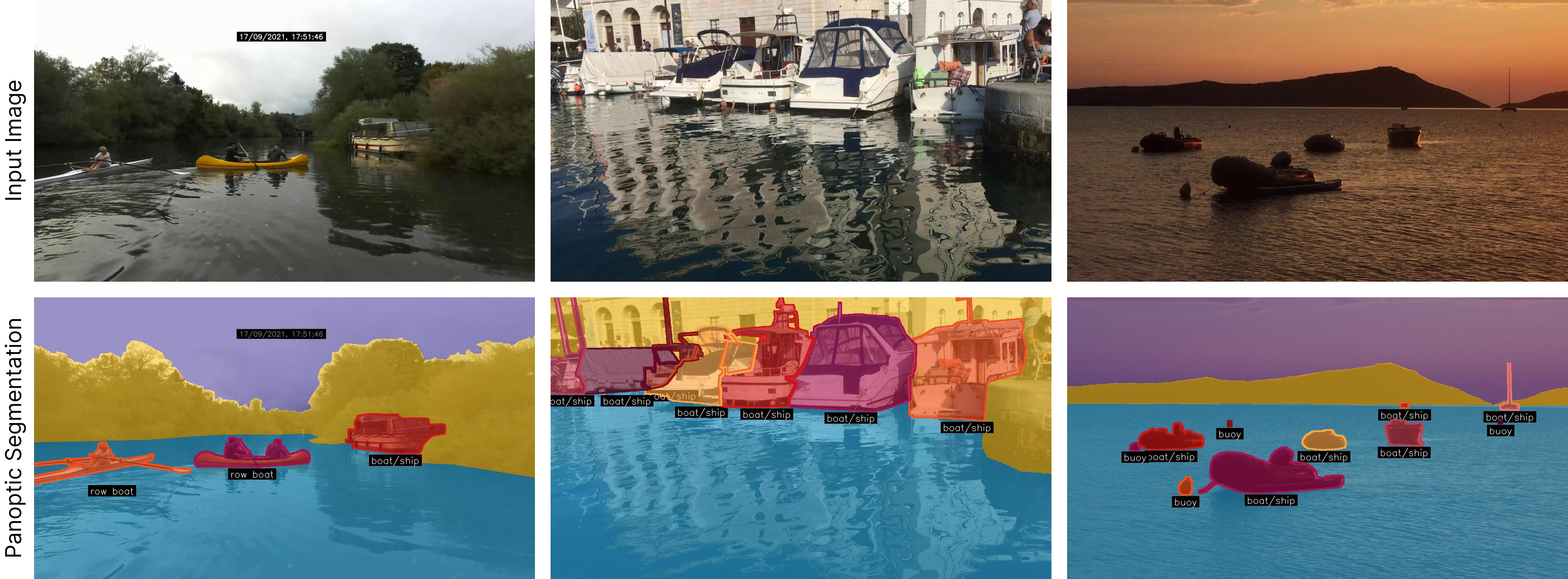
MaCVi 2025's USV challenges feature the LaRS Dataset. LaRS focuses on scene diversity and covers a wide range of environments including inline waters such as lakes, canals and rivers. To perform well on LaRS, one needs to build a robust model that generalizes well to various situations.
For the Panoptic Segmentation track, your task is to develop a panoptic segmentation method that parses the input scene into several background (stuff) and foreground (things) categories. The method should segment individual instances of the foreground classes. You may train your methods on the LaRS training set, which has been designed specifically for this use case. You may also use additional publicly available data to train your method. In this case, please disclose this during the submission process.
Create a panoptic segmentation method that parses the input scene into several background (water, sky, static obstacles) classes and foreground (dynamic obstacles) instances.
LaRS consists of 4000+ USV-centric scenes captured in various aquatic domains. It includes per-pixel panoptic masks for water, sky and different types of obstacles. On a high level, obstacles are divided into i) dynamic obstacles, which are objects floating in the water (e.g. boats, buoys, swimmers) and ii) static obstacles, which are all remaining obstacle regions (shoreline, piers). Additionally, dynamic obstacles are categorized into 8 different obstacle classes: boat/ship, row boat, buoy, float, paddle board, swimmer, animal and other. More information >
This challenge is based on the panoptic segmentation sub-track of LaRS: the annotations include panoptic segmentation masks which denote regions in the image belonging to each segment (i.e. instance), and an annotation JSON file containing annotations (class, etc.) for each segment in the dataset.
We select the commonly used Panoptic Quality (PQ) as the evaluation metric for evaluating panoptic method performance on LaRS. We also report separated PQ performance for thing and stuff classes as well as PQ reduced into its contributing parts, recognition quality (RQ) and segmentation quality (SQ).
To determine the winner of the challenge the PQ metric (higher is better) will be used.
Furthermore, we require every participant to submit information on the speed of their method measured in frames per second (FPS). Please also indicate the hardware that you used for benchmarking the speed. Lastly, you should indicate which data sets (also for pretraining) you used during training.
To participate in the challenge follow these steps:
instance_id = G * 256 + B)0: VOID1: [stuff] static obstacles3: [stuff] water5: [stuff] sky11: [thing] boat/ship12: [thing] row boat13: [thing] paddle board14: [thing] buoy15: [thing] swimmer16: [thing] animal17: [thing] float19: [thing] other